Have you ever noticed your child pick up a word or phrase simply by observing and imitating what they’ve heard without being taught it?
This is because learning to talk typically occurs naturally. From an early age, children begin communicating through babble and mimicking sounds, then progress to understanding and producing words, phrases and eventually sentences. This happens from being immersed in an environment where they are continuously exposed to spoken language and engage in rich interactions with those around them.
Learning to Read however, is a far more complex and cognitive process that doesn’t follow such a natural pathway. Let me explain…
Aligning with current research, there are a few fundamental ingredients that children must know, understand and use simultaneously to be successful readers. One of these key ingredients is phonological awareness.
What is Phonological Awareness?
Phonological awareness (PA) is a term used to describe the ability to recognise and manipulate sounds in spoken language. It’s oral and auditory based and is divided into four components that increase with complexity and build on from one another. Mastering this ability requires explicit teaching that is developmentally appropriate and loads of practice.
Below is a brief snapshot of the components to give insight and context of how PA develops, as well as a few playful activity suggestions to capitalise on conversations and inject teachable moments during play.
1. Word Level
At this level, it’s all about exploring words; whether they are long or short, how many we say in spoken sentences and rhyme. Engaging in simple rhyme activities, encourages children to tune into sounds within words to then manipulate and produce words with the same pattern. It’s a lot of fun and can take the form of all sorts of activities. Here’s just a couple of suggestions.
Rhyming Picture Sort: draw rhyming pictures onto square CONNETIX using a chalk marker. Mix them up and have children search for the matching pairs.
Oral Rhyme Posting Boxes: Make posting boxes (cubes) using CONNETIX and write an end sound on the front. For example /-ig/. Create corresponding words tiles that are to be read aloud for children to post into the box of the associated rhyme.
2. Syllables
When approaching unknown words, children need to be able to segment (break) words into smaller chunks – known as syllables. Once they move from being able to sound out and read simple words for example those with three sounds, they will need a strategy to attack longer, more complex words. This is where understanding syllables becomes important as they can then segment the unknown word into smaller, manageable chunks to read. Here’s a couple of activities that encourage this skill.
Build a train using CONNETIX and write numerals 1,2,3 and 4 on the carriages. These numerals represent the number of syllables in words, you can adjust how many carriages you include according to their ability level. Draw some pictures on triangular tiles and ask your child to say the word, break it into syllables then post it in the corresponding carriage. For example, the tiles with the flower would be posted in the 2nd carriage.
Create a giant ladder on the floor using CONNETIX. Hold up a picture tile and ask your child to jump over the rungs for every syllable. For example, jumping over two ladder rungs for the word /carrot/.
Syllable Dots: Put a dot in the middle of four small rectangle CONNETIX. As with the activity above, these dots represent the number of syllables in words. Using picture tiles or orally calling words out, ask your child to tap out the syllables by touching the dot as they say the word. For example, for the word /banana/ they would tap the first dot as they say /ba/, the second dot as they say /na/ and the third dot as they say /na/.
3. Onset-rime
Onset-rime is all about the way words can be broken into parts. The onset refers to the initial consonant sound(s) and the rime is the vowel and consonants after. For example, for the word jam the onset is /j/ and the rime is /am/.
Understanding this concept and being able to identify these patterns in words assists children’s automaticity to recognise letter patterns which in turn benefits their ability to decode unknown words. Here’s a fun game to play around with the concept.
Onset Bingo: For this activity you will need a Baseplate per player and matching picture tiles or counters for each player. To make the Bingo board, draw a picture on each square of the baseplate. Make sure that each baseplate is slightly different. Create matching picture tiles (or create a wordlist), call out pictures at random by saying first the onset and then the rime, for example c – at. If your child has that corresponding picture, have them put the matching picture or a counter on it. The first player to have a full row of pictures or counters, calls BINGO.
4. Phonemic Awareness
Phonemic awareness is considered the most significant component and builds upon the foundational knowledge and skills mastered in the above three. It’s all about understanding that words are made up of sounds and tuning in to how they can be blended, segmented and manipulated to form new words.
Research suggests that fast and accurate identification of sounds reduces children’s cognitive load, allowing them to focus on blending words. Engaging in playful activities around sound knowledge is therefore hugely beneficial. Here’s a couple of ideas.
Make a spinner with a hexagon CONNETIX by pushing a pencil through the middle hole and winding an elastic band around it on either side of the hexagon. Using a chalk marker, write individual sounds in each section of the hexagon tile. Spin the spinner and say the sound it lands on. An extension to this is to say words that begin/ end with that sound.
Hide figurines or picture cards in a muffin tin and cover with a CONNETIX. Ask your child to lift a tile at random and say what sound the figurine/ picture starts with.
Photo credit: @littleplayideas
Use the free Alphabet printables available on the CONNETIX website to make individual sounds. While making them, talk about what sound it makes, brainstorm words that start with that sound or where they may have seen it before. For example their name, street signs, shopping list etc.
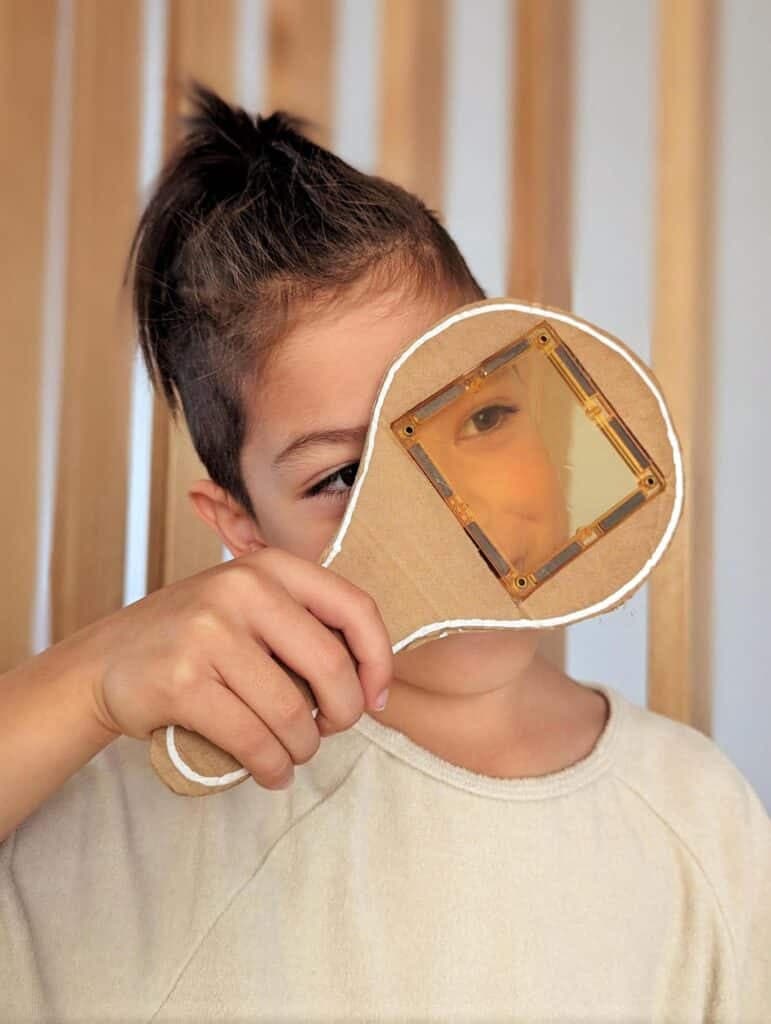
Go on a sound hunt. Make a magnifying glass with a CONNETIX by cutting out a magnifying glass shape from cardboard and attaching a square tile in the middle. Walk around the home saying items seen and what sound they start/ end with.
To set children up for reading success, it’s beneficial for families to have a level of understanding of the complex components at play, with phonological awareness being just one of those. These skills take time, practice and loads of repetition so let’s capitalise on the opportunities that CONNETIX present and enjoy fun activities that lay the groundwork for early reading.